
Bulk T-Shirts for Resale: What You Need to Know Before You Order
Ordering T-shirts for resale is different from ordering for a team or event. The decisions you make affect your margin, your stock levels and how easily you can sell what you produce.
The goal is not just to get T-shirts printed. The goal is to produce something that sells, at a cost that leaves room for profit.
This guide focuses on the key areas that matter when you are bulk ordering customised T-shirts for resale.
Start With Your End Goal
Before placing an order, be clear about what you are trying to achieve.
Most resale orders fall into one of these categories:
- A new clothing or merchandise line
- Event merchandise with expected demand
- Promotional products for resale or distribution
- Ongoing stock for a brand or business
Each of these has different requirements, but they all rely on the same fundamentals. Cost control, consistency and demand planning.
Why Quantity Matters More for Resale
When you are selling T-shirts, the cost per unit becomes the most important factor.
Smaller orders may feel safer, but they usually come with higher unit costs. That reduces your margin and limits how competitively you can price your product.
Larger orders improve your position:
- Lower cost per T-shirt - more profit for you
- More stock available to sell - fewer disappointed customers
- Better control over pricing - control is everything in today's business
This is why resale orders often start at higher quantities than standard bulk orders.





Choosing the Right Quantity for Resale
The right order quantity depends on your confidence in demand, but there are clear starting points.
150 T-Shirts
Suitable for testing a design or launching a small run. It allows you to validate demand without committing to large volumes.
500 T-Shirts
A strong entry point for resale. It provides enough stock to sell at scale while benefiting from improved pricing.
1000 T-Shirts
Designed for serious production. This level supports wholesale, consistent stock and stronger margins.
If you expect steady demand, larger quantities are usually more efficient. If demand is uncertain, a mid-range order reduces risk while still improving cost per unit.
Choosing the Right Print Method for Resale
Print method has a direct impact on both cost and product quality.
Screen Printing for Resale
Screen printing is the most common choice for resale because it is built for volume.
- Lower cost per unit at higher quantities
- Clean, bold finish that works well for retail
- Consistent results across large runs
It works best with simple designs using a limited number of colours.
Full Colour Printing for Resale
Full colour printing can still be used for resale, particularly for smaller runs or detailed designs. It offers flexibility, but does not scale as efficiently at higher volumes.
For most resale-focused orders, screen printing provides the strongest balance of cost and consistency.
Designing T-Shirts That Sell
A good design is not just about how it looks. It needs to work in the context of your audience and your product.
When designing t-shirts for resale, focus on:
- Clear, recognisable graphics
- Strong contrast and visibility
- Designs that work across multiple sizes
- Simplicity that suits the print method
Overly complex designs can increase cost and reduce consistency, particularly with screen printing.
Choosing the Right Garment
The T-shirt itself is part of the product you are selling, so it needs to meet expectations.
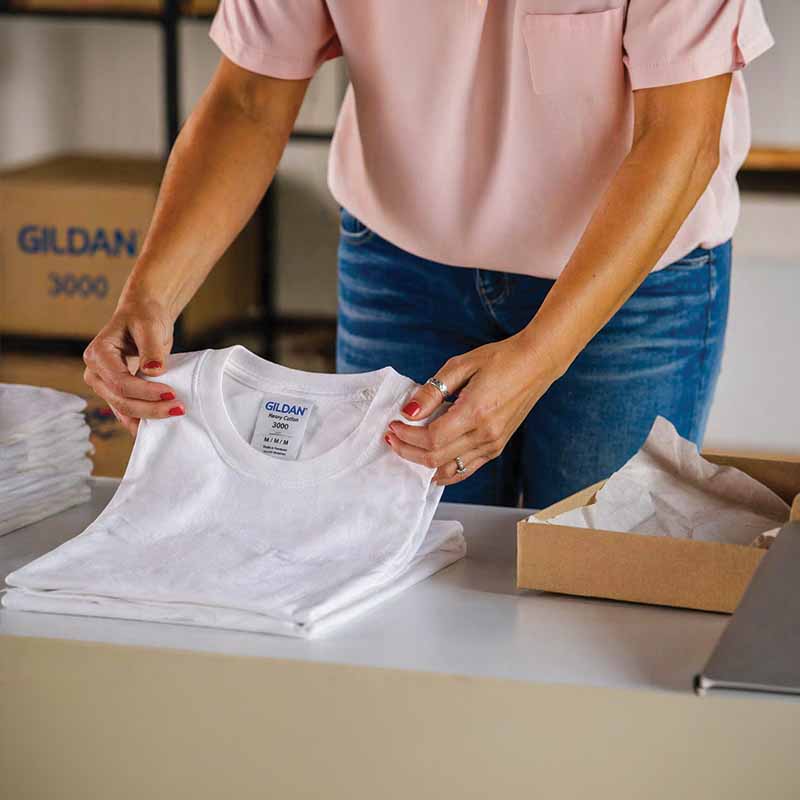
The Gildan 3000 Heavy Cotton T-Shirt is widely used for resale because it provides a reliable base.
- Lightweight feel suitable for broad audiences
- Consistent sizing across large runs
- Strong compatibility with bulk printing methods
For resale, consistency is key. Customers expect the same fit and quality across every unit.
Planning Your Size Distribution
Size distribution has a direct impact on how well your stock sells.
A typical resale size curve includes:
- Medium and large as the core sizes
- Smaller quantities of small and extra small
- Controlled quantities of larger sizes
If you have access to previous sales data, use it. If not, a balanced approach usually performs well.
Avoiding Common Resale Mistakes
There are a few mistakes within your order process that can limit the success of a resale campaign.
Ordering too few units
This limits your ability to sell and often leads to a second order at a higher cost.
Choosing the wrong print method
A method that does not scale well can reduce your margin.
Overcomplicating the design
Complex designs can increase production costs and reduce consistency.
Poor size planning
Having too much stock in less popular sizes can slow down sales.
Avoiding these issues improves both efficiency and profitability.
Thinking Beyond the First Order
A resale order should not be viewed in isolation. It should be part of a wider plan.
Consider:
- Whether you will reorder the same design
- Whether you will expand into new designs
- How quickly you expect to sell through stock
Screen printing supports repeat production, making it easier to maintain consistency across multiple runs.
Bringing It All Together
When ordering bulk T-shirts for resale:
- Define your product and audience
- Choose a quantity that supports your sales goals
- Select a print method that scales efficiently
- Keep the design clear and suitable for printing
- Plan your size distribution carefully
This approach ensures your order works commercially, not just operationally.
What Happens Next?
Once you understand how resale orders work, the next step is choosing the right bundle size and print method for your production run.
That decision will determine your cost per unit, your margin and how effectively you can scale.
With the right setup, bulk T-shirt ordering becomes a repeatable and reliable part of your business.
- Custom T-Shirts for Businesses: Bulk Ordering Made Simple - 21st April 2026
- Bulk T-Shirt Pricing Explained: 50 vs 150 vs 500 vs 1000 - 21st April 2026
- How Many Custom T-Shirts Do You Need for Your Event or Team? - 21st April 2026