
How Many Custom T-Shirts Do You Need for Your Event or Team?
One of the most common questions when ordering bulk custom T-shirts is how many to buy. The answer is rarely exact, but getting close matters.
Order too few and you create problems. Order too many and you tie up budget in unused stock. The goal is to find a number that covers your needs with enough flexibility to avoid issues later.
This guide helps you work that out based on how your T-shirts will be used.
Start With the Purpose of the T-Shirts
Before you think about numbers, define what the T-shirts are for. Different uses require different approaches.
Teams and staff
If the T-shirts are for employees or a defined group, start with your headcount. Then build in a margin for flexibility.
People will need different sizes. Some may want a spare. New starters may join after the order is placed.
Events and promotions
Event planning introduces more variables. You may be ordering for staff, volunteers, giveaways or sales.
Attendance is not always predictable, so relying on a fixed number can create risk.
Merchandise and resale
If you are selling T-shirts, the calculation shifts. You are not just covering demand, you are trying to meet it efficiently.
This means thinking about expected sales, not just initial distribution.

Build Your Base Number
Once the purpose is clear, calculate your starting point.
For most orders, this is a simple total:
- Number of people who need a T-shirt
- Number of T-shirts you expect to sell or distribute
This gives you a baseline, but it is not your final quantity.
Add a Practical Buffer
A buffer is essential in bulk orders. It protects you from common issues that arise after the order is placed.
Typical reasons for adding extra units include:
- Incorrect size selection
- Additional attendees or staff uniforms
- Damaged or lost items
- Unexpected demand
A buffer of 10 to 20 percent is usually enough to cover these scenarios.
This small increase often prevents the need for a second order, which is almost always less efficient.
Matching Your Quantity to Bulk Levels
Once you have your estimated total, the next step is aligning it with practical bulk quantities.
Most orders naturally fall into one of these ranges.
Around 50 T-Shirts
An order of 50 t-shirts is suitable when:
- You are ordering for a small team
- You need a short-term solution
- You are testing a design
It provides flexibility with a lower upfront cost, but the cost per unit is higher than larger orders.
Around 150 T-Shirts
This is the most common choice for group orders. It works well when:
- You are covering a full team or event
- You want a balance between cost and flexibility
- You need enough stock to avoid running short
For many customers, 150 t shirts is the most practical option.
Around 500 T-Shirts
This level is suited to larger distribution. XAMAX® do bundles of 500 t-shirts in full colour print or in screen print.
It works well when:
- You are supplying a large audience
- You are running a promotion at scale
- You are producing merchandise
The cost per unit becomes more efficient, and the order supports wider use.
Around 1000 T-Shirts
This is used when volume and efficiency are the priority.
It works well when:
- You are producing for resale
- You need consistent stock
- You want to maximise cost efficiency
At this level, the order becomes part of a larger plan rather than a one-off requirement.





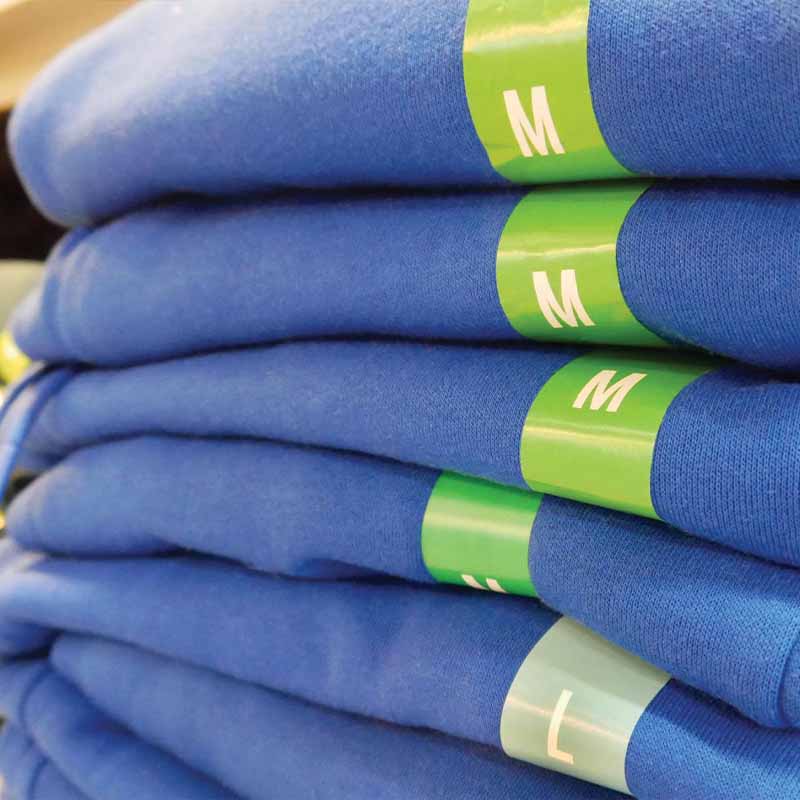
Planning Size Distribution Properly
Quantity alone is not enough. You also need the right mix of sizes.
A common approach is to follow a simple distribution:
- Small and extra small in lower quantities
- Medium and large as the core sizes
- Extra large and above based on expected demand
If you are unsure, it is better to slightly over-order medium and large, as these tend to be the most common.
For resale, reviewing past sales data gives the most accurate result.

Avoiding the Most Common Mistake
The biggest issue with bulk T-shirt orders is under-ordering.
It often happens because the initial number feels too high, so it is reduced to stay within budget.
This creates a situation where:
- Demand is not fully met
- A second order is required
- The overall cost increases
Increasing the quantity slightly at the start usually delivers better value and avoids disruption.
How the T-Shirt Choice Affects Your Decision
The garment itself plays a role in how you plan your order.
The Gildan 3000 Heavy Cotton T-Shirt is widely used in bulk orders because it offers a consistent and practical base.
- Lightweight feel suitable for most users
- Reliable sizing across large quantities
- Strong compatibility with different print methods
This makes it easier to plan your quantity with confidence, as you know the product will perform consistently across the full order.
Bringing It All Together
To arrive at the right number:
- Define how the T-shirts will be used
- Calculate your base requirement
- Add a practical buffer
- Align with a bulk quantity level
- Plan your size distribution
This approach removes guesswork and helps you place an order that works in practice.
What Happens Next?
Once you know how many T-shirts you need, the next step is choosing the right print method for your design and quantity.
That decision will affect both the cost and the final result.
Getting both the quantity and print method right ensures your order delivers what you expect.
- Custom T-Shirts for Businesses: Bulk Ordering Made Simple - 21st April 2026
- Bulk T-Shirt Pricing Explained: 50 vs 150 vs 500 vs 1000 - 21st April 2026
- How Many Custom T-Shirts Do You Need for Your Event or Team? - 21st April 2026