
Bulk T-Shirt Pricing Explained: 50 vs 150 vs 500 vs 1000
When you order custom T-shirts in bulk, the total price matters. The cost per T-shirt matters more.
Two orders can look similar at first glance, but the difference in quantity can change the cost per unit significantly. That difference affects your budget, your margins and how far your order goes.
This guide explains how pricing works across the most common bulk quantities, so you can choose the right level for your needs.
Why Quantity Changes Everything
The reason bulk pricing works is simple. The production process becomes more efficient as the number of T-shirts increases.
There are fixed elements in every order:
- Artwork setup
- Print preparation
- Machine time
- Handling and packing
These costs do not increase in proportion to quantity. When you spread them across more units, the cost per T-shirt drops.
This is why moving from 50 to 150 units can make a noticeable difference and why larger runs are more cost-effective overall.
Understanding the Pricing Ladder
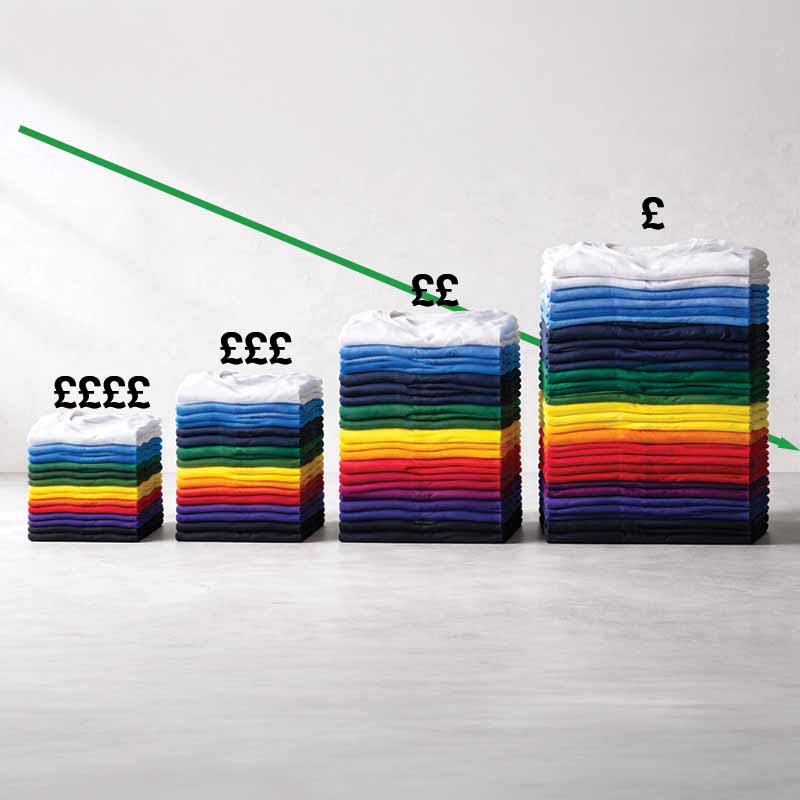
Most bulk T-shirt orders fall into four key levels. Each level serves a different purpose.
50 T-Shirts: Entry-Level Bulk
This is the starting point for bulk orders. It gives you access to bulk pricing without a large upfront commitment.
It works best when:
- You need T-shirts for a smaller group
- You are testing a design or idea
- You want to keep initial costs low
The cost per unit is higher than larger orders, but the flexibility is useful. This makes it a practical option for short-term use or first-time orders.
150 T-Shirts: The Most Practical Option
This is where bulk pricing starts to work properly. It offers a strong balance between cost, quantity and flexibility.
It works best when:
- You need T-shirts for a full team or event use
- You want better value without committing to very large volumes
- You need a mix of sizes and colours
For most customers, this is the point where the order becomes both cost-effective and practical.
500 T-Shirts: Scale and Efficiency
At 500 units, the focus shifts toward efficiency. The cost per T-shirt drops further, and the order starts to support wider distribution.
It works best when:
- You are supplying a large audience
- You are running a promotion at scale
- You are producing merchandise
This level is often used when T-shirts are being distributed across multiple groups or locations.
1000 T-Shirts: Maximum Value at Volume
This is where bulk ordering becomes a production decision rather than a purchase.
It works best when:
- You are producing T-shirts for resale
- You need consistent stock
- You want to maximise margin per unit
At this level, the cost per T-shirt is at its lowest, and the order becomes a long-term asset rather than a short-term requirement.




Cost Per Unit vs Total Spend
One of the most common mistakes, especially for business use, is focusing only on the total order value.
A smaller order will always cost less upfront, but the cost per T-shirt is higher. A larger order costs more overall, but delivers better value per unit.
The key is understanding what matters more in your situation.
When Total Spend Matters Most
If you are working within a fixed budget, a smaller order may be the right choice. This allows you to control costs while still achieving your objective.
When Cost Per Unit Matters Most
If you are distributing or selling T-shirts, the cost per unit becomes critical. Lower unit costs improve your overall efficiency and potential return.
In many cases, increasing the quantity slightly can improve value without creating unnecessary excess.
How Print Method Affects Pricing
The print method plays a key role in how pricing scales.
Full Colour Printing
Full colour printing offers flexibility across all quantities. It works consistently whether you are ordering 50 or 150 units.
It is a practical choice when design complexity is important.
Screen Printing
Screen printing becomes more efficient as quantities increase. The setup cost is spread across more units, reducing the cost per T-shirt.
This is why it is commonly used for 500 and 1000 unit orders, particularly for merchandise and resale.
Choosing the right print method for your quantity can improve both cost and outcome.
Planning for the Right Quantity
The right quantity is not always the smallest or the largest option. The answer to how many t-shirts you need directly fits your use case.
Consider:
- How many people need a T-shirt
- Whether you need spare stock
- Whether the T-shirts will be sold or distributed
- Whether you may need to reorder
A slightly larger order can often remove the need for a second run, which is usually more expensive in the long term.
The Role of the T-Shirt Itself
The garment also plays a part in pricing and performance.
The Gildan 3000 Heavy Cotton T-Shirt is commonly used for bulk orders because it provides a consistent and cost-effective base.
- Lightweight feel suitable for wide audiences
- Reliable sizing across large runs
- Good surface for both screen and full colour printing
Choosing a dependable garment helps ensure the entire order performs as expected.
Making the Right Choice
The decision comes down to how your order will be used.
If you need flexibility and lower commitment, a smaller quantity makes sense. If you need efficiency, distribution or resale potential, larger quantities deliver better value.
Most customers find that the middle range offers the best balance, while higher volumes provide the strongest commercial advantage.
What Happens Next?
Once you understand how pricing works, the next step is choosing the right combination of quantity and print method.
That decision will determine how your order performs in terms of cost, quality and usability.
The rest of this guide series explores those choices in more detail, helping you move from planning to placing your order with confidence.
- Custom T-Shirts for Businesses: Bulk Ordering Made Simple - 21st April 2026
- Bulk T-Shirt Pricing Explained: 50 vs 150 vs 500 vs 1000 - 21st April 2026
- How Many Custom T-Shirts Do You Need for Your Event or Team? - 21st April 2026